Showing posts with label climate change. Show all posts

July 24, 2023

Some shameless punning on the Farm Bill


(You've goat to read this)


As someone who has dabbled in farming, I find it difficult to write about an important topic like the federal Farm Bill without indulging in at least a few agricultural puns—even though punning has a baad reputation.

The 17th century English poet John Dryden, for example, referred to punning as “the lowest and most groveling kind of wit.”

Oliver Wendell Holmes Senior, 19th century American physician and poet, said “A pun does not commonly justify a blow in return. But if a blow were given for such cause, and death ensued, the jury would be judges both of the facts and of the pun, and might, if the latter were of an aggravated character, return a verdict of justifiable homicide.”

Mark Twain, whose pen name was itself a pun (the pen pun was unintentional by the way), wrote that “no circumstances, however dismal, will ever be considered a sufficient excuse for the admission of that last and saddest evidence of intellectual poverty, the Pun.”

 I have no beef with such writers or their sage advice, but at the risk of being corny it’s still chard not to.

The Farm Bill is a huge piece of legislation that comes up every hive years and Congress has goat to pass this year. It’s an omnibus bill, meaning that it combines several distinct acts that clover everything from hunger to flood control. But it helps to take it one bite at a time.

Here are some things that ordinary people all over the US and especially in West Virginia need to bee in the bill and that we need to count on Senators Capito and Manchin and Congresswoman Miller to support:

*Food assistance. Let’s face it. Millions of Americans barley get enough to eat--as in 33 million nationwide and over 200,000 here. That situation has gotten worse with the ex-pear-ation of COVID-era safety net provisions and recently passed federal legislation. Last time around, in 2018, our senators carroted enough to support a clean Farm Bill without more restrictions for food insecure people even though they were going against the grain. Let’s hope they do that again.

*Flood control. Irrigation is berry important to farming, but I think most of us would prefer that it not happen to our roads, homes, businesses, and towns. And that it should water our fields without washing them away. A good Farm Bill would help farmers recover from disasters, pre-pear for future ones, and support conservation practices that can reduce flooding.

*Support small farms and farmers. Millions of taxpayer dollars go to subsidize large scale corporate and industrial operations that are inhumane to animals, farmworkers and unsustainable for the environment. You don’t need a fertile imagination to realize that the money would be beet-er spent supporting smaller family farms and local food systems.

*Address climate change. You don’t have to be a farmer to realize that the weather is getting weirder and weirder, but you cane’t help but notice it if you are. A good Farm Bill should provide encourage-mint for regenerative agricultural measures that would conserve soil, prevent erosion, regrow forests, encourage cover crops, store carbon, and reduce emissions.

*Support creative approaches. It wood be win all around if the Farm Bill put more resources into school and community garden projects, urban agriculture, and small scale local projects that fight hunger and keep resources in the local economy. Also, it would be good to take steps to open farming opportunities to people who have been discriminated against in the past.

*Be kinder to our four-legged and feathered friends. Industrial livestock production crowds cattle, hogs, chickens, and other critters into Concentrated Animal Feeding Operations known as CAFOs. Aside from causing unnecessary misery, these create a-maize-ing amounts of animal waste and pollution and encourage the overuse of antibiotics that weaken their effect. They’re nothing to crow about and taxpayers shouldn’t relish the chance to subsidize them.

*Local processing. If the Strengthening Local Processing Act was part of the package, this would be an alternative to CAFOs by supporting local processing of animal products. Surely a meating of the minds is possible here.

*A missing piece. One thing that’s been lacking from previous Farm Bills is protections for the people who dew the work. Lettuce not forget that farm work is difficult and hazardous and much of it is done by children. Nothing against emergency responders, but risks are even higher in this field. Farming is routinely considered to be among the most dangerous occupations. Also, some farmworkers experience wage theft but are too intimidated to pursue redress, which drives down wages for everyone.

*Child care. And how can we forget the kids? Senator Brown from Ohio has rounded up bipartisan support for including the Expanding Childcare in Rural America Act, which would provide more child care in rural communities. Farm work can eat up some long hours in places where there often aren’t good child care providers. It would be great if every child barn in a farming community could enjoy good care when the adults are fending off possums and such.

I realize that this is quite a grocery list, but this is a REALLY big bill and there’s no time for stalling. If we want a decent bill for everyone, we need to turnip the noise and kale our representatives this summer. It’s time to broc and roll.

(This ran as an op-ed in the Charleston Gazette-Mail.)

July 11, 2023

Pipeline blues

The Fiscal Responsibility Act of 2023 prevented a U.S. default which would have sent shockwaves across the global economy. Radical proposals that would have imperiled low- income people’s access to health care were thankfully not included.  In short, it could have been a lot worse.  Yet still there were casualties. 

Flat budgets for domestic discretionary spending essentially are funding cuts in programs for everything except military spending. The bill will take away food assistance from more adults without dependents by way of time limits linked to so-called work requirements for the Supplemental Nutrition Assistance Program (SNAP).  Although thankfully there were carveouts for veterans, kids aging out of foster care, and people experiencing homelessness. 

One particularly unpleasant surprise was the free pass for the Mountain Valley Pipeline (MVP), which has nothing to do with fiscal responsibility much less a federal spending issue. 

The language for MVP included in the bill legislatively approves all permits necessary to complete the construction of the pipeline extending from West Virginia to Virginia.  The other mandate in the bill is that all judicial reviews of permit approvals are blocked. 

The greenlight for the MVP flies in the face of over 500 water quality and permit violations the project has accrued, the multiple delays by successful legal challenges, and significant pushback from West Virginians for nearly a decade since the pipeline was first proposed in 2014.   

Lobbied for by those who stand to profit from its completion (of course), including MVP in the debt-ceiling deal is a sneaky way to circumvent permitting requirements and prevent the public from contesting decisions in court.

One of the flimsy rationales for the MVP is based on the premise that we need a natural gas pipeline for energy independence and to meet market demands.  Suzanne Mattei with Institute for Energy Economic and Financial Analysis wrote recently, “the international export of gas is trending toward a glut rather than a shortage.” 

Furthermore Mattei points out, “Market conditions do not justify forcing decisions on both state and federal agencies under federal law or revoking the public’s right to judicial review of agency action.”

Last but not least, anyone notice changes in the weather these days?  The sun shines a bit hotter.  Flowers bloom a bit earlier.  The rain pours a bit harder.  Creeks rise a lot faster.  And just this week millions of people are breathing hazardous air from wildfires burning in Canada.  

To be sure, while the MVP is controversial, the facts and consequences of climate change are not.  Fossil fuel projects like the MVP is pouring proverbial gasoline on the fire of the climate crisis. 

In contrast to the MVP maneuver, the Inflation Reduction Act (IRA) which passed last year could be a real game changer for West Virginia.  The IRA means massive tax incentives and federal dollars for West Virginia to invest in a clean energy economy, new jobs, and lower energy costs, all while mitigating the harms of climate change.   

The IRA is the kind of bold investments that will help keep West Virginia wild and wonderful, but the MVP and the continued reliance on fossil fuels will have detrimental impacts both in West Virginia and around the globe.  

That’s why people aren’t giving up the fight. Because future generations are depending on us to not keep making the same mistakes.  

(This appeared as an op-ed by Lida Shepherd in the Charleston Gazette-Mail a while back. Sorry for hiatus lately.)


August 16, 2022

WV Climate Alliance on Inflation Reduction Act: "A good first step"

The WV Climate Alliance is composed of representatives of more than 20 state organizations (including AFSC) concerned about  the threat of climate change. The group released this statement to coincide with the signing of the bill into law.

Charleston, WV: The WV Climate Alliance has come together to release a joint statement in support of the Inflation Reduction Act as a “Good First Step”. Passage by the House Friday puts this historic legislation on president Biden’s desk for his signature. This legislation will now begin to move our nation forward in addressing our ever escalating Climate Crisis.

“We’d like to recognize Senator Manchin’s leadership for co-sponsoring this legislation,” said Gary Zuckett, Executive Director of WV Citizen Action Group, “and for his efforts to advance these reforms even in the face of total Republican opposition, outright lies broadcast 24-7 by dark money groups over social and regular media, and intense lobbying from Big Pharma, oil companies and other corporate special interests. In these tough times, West Virginians have been waiting long enough for these common-sense improvements.” 

"Once enacted, the Inflation Reduction Act of 2022 will help more West Virginians take control of where their energy comes from at a time when it’s needed most,” said Leah Barbor, West Virginia Program Director, Solar United Neighbors. “These clean energy investments will put us on track to reduce emissions, reduce energy bills, create good jobs and improve equity by expanding the opportunities to bring the benefits of solar to all West Virginians.”

“We want to thank Senator Manchin for ensuring the IRA passage. The IRA is truly a historical step forward,” said Lead West Virginia Veteran and Climate Justice Organizer Lakiesha Lloyd with Common Defense. “However, we must recognize that there is still much to do. We have a long way to go to ensure a renewable energy future where West Virginia veterans will not only survive but thrive. Thus, we’ll keep organizing–this bill is the step we need on our path to full climate justice.”  

“The Inflation Reduction Act is a once-in-a-lifetime opportunity to invest in climate solutions that will help protect West Virginia from the impacts of the climate crisis for generations to come. The WV Environmental Council (WVEC) thanks Senator Manchin for supporting this legislation. West Virginia now has a chance to fight climate change, create jobs and be a part of a clean energy future. WVEC is committed to continuing our advocacy for solutions that promote environmental protection across the state and advance environmental justice,” said Linda Frame, President of the West Virginia Environmental Council.

“We thank Senator Manchin for his support and leadership on the Inflation Reduction Act,” said Lucia Valentine, West Virginia Organizer of Moms Clean Air Force. “This historic investment in our future comes at a crucial time in Appalachia, as devastating floods remind us of the urgency to act for the safety of our children and for future generations. The Inflation Reduction Act puts us on a path to a cleaner, safer, and healthier future.”

“This legislation includes a permanent extension of the Black Lung Excise Tax – an unprecedented investment in the Black Lung Disability Trust Fund. This is a huge victory for every miner and mining family that is worried about how to pay for their bills and medication in light of the uncertainty around the Black Lung Disability Trust Fund. In West Virginia alone, 4,423 miners and their families are currently receiving federal black lung compensation. The Black Lung Disability Trust Fund provided $38 million in black lung compensation to West Virginia miners in 2021, or nearly 25% of the total funds disbursed nationally,” said Dana Kuhnline, Campaign Director for ReImagine Appalachia.

“The Inflation Reduction Act is an important measure towards ensuring the livability of our planet.  For West Virginians who have been fighting for just transitions, economic diversity, and growth, we believe this to be a giant step in the right direction”, stated Kathy Ferguson, Interim Executive Director with Our Future West Virginia. “However, we must acknowledge the trade-offs and we lament that the MVP will be bolstered at the expense of the IRA passage.  We will certainly keep pushing for Sen. Manchin to go further in ensuring that people are prioritized over profits and that all our communities are protected and environmentally sound.”

“The passage of the Inflation Reduction Act puts our nation on the pathway toward unprecedented greenhouse gas emissions reduction,” said Autumn Crowe, Program Director of the West Virginia Rivers Coalition. “While we celebrate this milestone, our work is not done. We recognize that some provisions within the IRA call for additional fossil fuel development which perpetuates the harm to frontline communities. We will continue to advocate for healthy communities and work toward 'net zero' greenhouse gas emissions.”

While the Climate Alliance is hopeful about this historic step forward in climate policy, much more is needed to be done. We will continue advocating for the advancement of climate solutions that focus on our three pillars of reform: climate justice for communities that have borne the brunt of our current fossil-fuel economy; a true transition for coal miners and other fossil fuel workers likely to be impacted by the transition to a low-carbon economy; and a significant reduction in greenhouse gasses in accordance with the findings of the UN Intergovernmental Panel on Climate Change.

________________


FOUNDED in 2020, the WEST VIRGINIA CLIMATE ALLIANCE is a broad-based coalition of almost 20 environmental organizations, faith-based, civil rights and civic organizations, and other groups with a focus on climate change. Members of the Alliance work together to provide science-based education on climate change to West Virginia citizens and policymakers. 


FOR MORE ON THE CLIMATE ALLIANCE, VISIT: WVClimateAlliance.org

August 04, 2022

A yo-yo year

 Lots of people I know, myself included, spent a lot of time over the last year trying to get something across the line in terms of a federal reconciliation bill. We started with high hopes and saw things go off the rails on more than one occasion. 

Now, a possible new bill could be voted on very soon, one largely negotiated by a certain senator from West Virginia who has been front and center throughout the process. Although there are plenty of things in the bill not to like, and some things we wanted didn't make it, this is the first major federal legislation to address climate change, while also preserving health care benefits for millions, reducing prescription drug prices, and fixing Black Lung funding.

I'm pleased and proud that this action alert in support of the legislation is at the top of the AFSC webpage.

The United Mine Workers union has also come out strong in support of the Inflation Reduction Act. The release reads in part:

“We are very pleased that Senator Joe Manchin (D-W.Va.) and Majority Leader Chuck Schumer (D-N.Y.) were able to come to an agreement on legislation that includes full and permanent funding of the excise tax that funds the Black Lung Disability Trust Fund. This will give victims of this insidious disease, their families and their survivors some peace of mind that the benefits they so desperately need will never be reduced.

“Senator Manchin never wavered in his commitment to secure the funding for this program, and he delivered. Thousands in the coalfields owe him yet another debt of gratitude, and the UMWA will never forget his dedication to getting this done.

“There is more to do regarding Black Lung, starting with the promulgation of a final rule to limit silica dust exposure in coal mines. We also must examine the entire Black Lung benefits system to make it more inclusive for victims, more efficient in the awarding of benefits, and to ensure its long-term viability in the face of a declining coal industry. The UMWA stands ready to meet with all stakeholders – victims and their families, labor, and industry – to work on solutions to these issues.

“We are also pleased to see that provisions were included in the IRA that will extend tax credits to renewable energy supply chain manufacturers that build plants in the coalfields, which will be a big step toward providing good jobs to these distressed communities. The enhanced tax credits for carbon capture and storage included in the legislation will also be a boon for coalfield jobs. We urge swift passage of this legislation by Congress.”

Now it looks like all eyes are on Senator Sinema. It's nice for once not to have to worry about someone from West Virginia breaking the deal. It would be nicer to finally get this one done.

July 28, 2022

Good news if the deal is sealed

 By now, I'm guessing most interested people have heard of the deal reportedly struck by Senators Schumer and Manchin on climate, prescription drugs, and health care. It was quite a reversal of fortune from the last two weeks.

Here's a brief statement in response penned by yours truly and AFSC DC colleague Peniel Ibe about the deal on Twitter:

Me:

Over the last year, many West Virginians worked hard to push a reconciliation bill across the line. While the outlines of the potential deal are not as bold as many hoped in addressing family economic security, we are optimistic and relieved to learn that an agreement on addressing climate change is within reach and appreciate protections for health care.  

Certain provisions in this bill will have tremendous benefits for the children and families in the Mountain State. Looking forward, we will continue to work with the Senator to ensure that components not included in the package, such as the Child Tax Credit, are enacted to provide even more support for West Virginia’s families and children.  

Peniel:

The existence of this bill is a testament to the commitment for advocates across the country to delivering much needed relief for our communities.  

The wins are hard fought, delivering on provisions to lower health care costs, reduce the deficit, tax wealthy corporations, and invest in some clean energy projects and the environment.  

But the losses are just as painful. As negotiations stalled, critical investments included in the initial package were cut, sacrificial compromises were made, and countless people lost out. The bill currently includes some counterproductive provisions that further entrench the use of fossil fuels into our society- disregarding the intensity of the climate crisis and calls from front line communities.  

Yet this plan to begin to address the needs in our communities’ wellbeing is still at risk of being cut to a point beyond meaningful impact. We call on all Senators to focus on delivering relief now as there is more to do. We have waited too long and we must no longer leave our communities needs unaddressed.  

Today, many people across the U.S. struggle to make ends meet—especially amid soaring costs of housing, groceries, and other goods. We must continue to call for massive investments in a robust care infrastructure, including monthly Child Tax Credit payments, paid family/medical leave, closing the Medicaid coverage gap and more. 

This is the only way to build vibrant communities. 

I'm still nervous and will be until the deal is actually sealed, but this was welcome news in tough times. 


July 15, 2022

WV climate groups respond to the latest from Manchin

 Climate Alliance representing dozens of regional groups underscores the urgency of the climate crisis; rally at Manchin office planned for Monday


Charleston, W.Va.– Senator Joe Manchin announced today that he wants to delay a  plan to use the money that wealthy corporations owe to pay for desperately needed projects to help our climate and workers. 

In response, the West Virginia Climate Alliance submitted a letter to Senator Manchin (letter here). When the letter was sent, the Alliance requested an in person meeting with Senator Manchin, noting they had not been able to meet with the Senator in over a year to discuss grassroots concerns about climate impacts in the state.

“Every day that we delay taking action on the climate crisis makes our weather more extreme and the implementation of solutions even more challenging. The country, and indeed the planet, need Senator Manchin to negotiate in good faith on a bill addressing the climate crisis with the goal of keeping global warming below an increase of 1.5 degrees Celsius. Passage of this bill should not be contingent on a one month inflation report,” said Perry Bryant, founder of the WV Climate Alliance.

Manchin’s move comes just one day after more than 100 homes, roads and bridges in McDowell County, WV were damaged from climate-related flooding. 

The Rev. Jeffrey Allen, executive director of the West Virginia Council of Churches, stated, “Climate change is a crisis of today. It’s flooding in West Virginia and Virginia; fires in the West; and drought here and abroad. There is an enormous cost that we already bear due to our lack of action and it’s a cost being borne by our neighbors. Passing climate change legislation is as local as it gets. This legislation is not only for our neighbors, but for all of those people who we care deeply about. For their sake, we cannot afford to delay any longer.”

As the letter to Senator Manchin notes: “The late Senator Byrd said many times that filibustering the Civil Rights Act of 1964 was his biggest regret; the decision troubled him for the rest of his life. We encourage you to deeply consider the broad implications of continued delays to act to mitigate the worst impacts of climate change, for your own children and grandchildren, and for all the children and grandchildren in our beautiful mountain state and across the world.”

Karan May, Sr. Campaign Representative for theSierra Club said, “Folks in Appalachia are among the hardest hit by the effects of climate change. West Virginians are paying the price for poor health outcomes from pollution; here and in Kentucky and Southwest Virginia, year after year, we are paying the enormous price for catastrophic flooding. Senator Manchin has the opportunity to facilitate meaningful change for his constituents and, yet, is choosing to walk away from legislation that could help alleviate this suffering.

We will continue to fight for policy that will address the climate crisis, while also putting money back into our communities with investments in clean energy and sustainable economic development.”

Linda Frame, President of the WV Environmental Council, said “After a year of good-faith discussions with Senator Manchin and his team it’s hard not to be deflated by this latest delay. We continue to urge Senator Manchin to seize this opportunity to do the right thing for our state, our country, and our planet because the alternative is unthinkable.” 

“The overall cost of building climate change resilient infrastructure, as well as the transition to a clean energy economy, can be paid for now,” said Eve Marcum-Atkinson, Comms. Coord. fFor WV Citizen Action Group. “Tax minimums for millionaires and the elimination of zero-tax-paying loopholes for corporations are how we do this. They have financially benefited from our people’s labor, our nation’s infrastructure, and our economy. We need them to pay their fair share to help us all, as we continue to struggle with the effects of rising prices, increases in dangerous storms, record temperatures, drought, flooding, and more. We need Senator Manchin to fully embrace this now, as climate change is a now issue, a global issue. It’s not going away.”

“No matter our race or income, we want to live and raise our families in healthy and safe communities. Done right, the reconciliation bill is an opportunity to create bridges across our differences rather than making them deeper. Appalachia has been hit hard both by climate change impacts and global energy shifts – with Black and brown communities seeing disproportionate impacts. At the same time, we have an incredible opportunity to mitigate the climate crisis by investing in the communities hardest hit. Appalachian communities need action from Congress, this delay on key climate provisions not only hurts communities struggling with flooding and job loss due to the downturn of the coal industry, it pushes back other urgent actions we need to see from Congress,” said Dana Kuhnline, Campaign Manager for ReImagine Appalachia. 

“Promoting good energy legislation is part of Senator Manchin’s role as chair of the Energy and Natural Resources Committee. We call on him to not further delay action on the issues he proclaims to champion. It’s past time to listen to the science that shows a transformational clean energy transition will mitigate climate change while saving lives and creating new jobs,” said Morgan King, climate campaign coordinator of WV Rivers Coalition.

PRESS ARE INVITED TO A MONDAY RALLY AT SEN. MANCHIN’S CHARLESTON OFFICE:

WV Citizen Action and other groups are calling on everyone who is concerned about passing robust Climate Change policy, and paying for it by making millionaires and tax-dodging corporations pay what they owe, to show up at Sen Manchin’s office at 900 Pennsylvania Ave., Charleston, WV 25302, at 5PM on Monday July 18th. If you can’t make it, call his office at  304-342-5855 and tell him to quit stalling on Climate and Taxes! For more info contact info@wvcag.org  Gary Zuckett @ 304-437-3701 or check out events on https://www.facebook.com/WVCAG 

###

FOUNDED in 2020, the WEST VIRGINIA CLIMATE ALLIANCE is a broad-based coalition of almost 20 environmental organizations, faith-based, civil rights and civic organizations, and other groups with a focus on climate change. Members of the Alliance work together to provide science-based education on climate change to West Virginia citizens and policymakers. 

FOR MORE ON THE CLIMATE ALLIANCE, VISIT: WVClimateAlliance.org

(The AFSC WV Economic justice Project is a proud member of the WV Climate Alliance)

June 30, 2022

The Supreme Cult strikes again

 As a native and lifelong resident of West Virginia, I find it particularly galling that the disastrous Extreme Court Supreme Cult Supreme Court EPA decision bears the name of a state suffering from the impacts of climate change and urgently in need of a transition to just and sustainable economy.

 West Virginians are intimately familiar with the human and natural consequences of not adequately regulating industries that harm our people, land and rivers.

 The history of this state is punctuated by industrial disasters and the slower but potentially more devastating impacts of pollution and environmental degradation. This SCOTUS decision will only make things worse. The struggle continues...

Along those lines, here's a link to a response to the decision from the national AFSC and here's the accompanying call to action.  

June 28, 2022

And when you pray...

The US Supreme Cult is on a roll lately, privileging gun rights over public safety and local democracy, and rating reproductive rights for rapists over the same for women.. The latest one is an affirmation of the kind of religion that gets rammed down people's throats whether they want it or not.

This statement on reversing Roe from the American Friends Service Committee, previously posted here, sums up my position on that issue. As for the latest ruling on prayer, I'll defer to a higher authority.

“Take care not to practice your righteousness in the sight of people, to be noticed by them; otherwise you have no reward with your Father who is in heaven...And when you pray, you are not to be like the hypocrites; for they love to stand and pray in the synagogues and on the street corners so that they will be seen by people. Truly I say to you, they have their reward in full. But as for you, when you pray, go into your inner room, close your door, and pray to your Father who is in secret; and your Father who sees what is done in secret will reward you." Matthew 6:1, 5,6 New American Standard Bible

Or, if you prefer the King James version: 

 "And when thou prayest, thou shalt not be as the hypocrites are: for they love to pray standing in the synagogues and in the corners of the streets, that they may be seen of men. Verily I say unto you, They have their reward. But thou, when thou prayest, enter into thy closet, and when thou hast shut thy door, pray to thy Father which is in secret; and thy Father which seeth in secret shall reward thee openly." Matthew 6:5, 6

I can hardly wait to see what they roll out next, but I'm especially dreading the ruling on climate change in a case that embarrassingly bears the name of West Virginia, which could have devastating consequences for the environment and public health.

It looks like a long and ugly road ahead.


December 20, 2021

AFSC WV statement on Senator Manchin and Build Back Better

 CHARLESTON, WV (December 20, 2021) Over the weekend, West Virginia Senator Joe Manchin announced on Fox News that he would not support the Build Back Better act. This comes after months of debate over the provisions in the bill, which would help families with childcare, improve the U.S. response to climate change, and strengthen the social safety net. The proposed legislation would also provide needed funding for Black Lung benefits.

The West Virginia program of the American Friends Service Committee (AFSC) – a Quaker organization active in the state for a century – issued the following statement calling on Manchin to change his position:

“A century ago, Quaker volunteers began working in solidarity with the people of West Virginia. There was severe economic hardship in the coalfields, with child poverty and hunger being key issues. Sadly, and perhaps incredibly, those issues are still very much alive in West Virginia, and we are still in the struggle to alleviate these challenging circumstances for people in our community.

During the 1920s and and1930s, AFSC administered direct relief to families in West Virginia and advocated for federal New Deal legislation to reduce unnecessary human misery, which transformed U.S. society. From the 1970s onward, AFSC accompanied and advocated for justice for coal miners and other workers, Black people, women, children, people in poverty, and other marginalized communities.

On many occasions, AFSC staff and volunteers collaborated with then legislator, later Governor, and now Senator Joe Manchin on state and federal issues ranging from the minimum wage and fair taxes to coal mine safety and preserving the gains of the Affordable Care Act.

We have also witnessed firsthand the better angels of our Senator’s nature in the compassion he has shown for victims of natural and human disasters. From the 1968 Farmington mine disaster, in which he lost an uncle, to the Aracoma, Sago and Upper Big Branch mine tragedies in the 2000s and beyond, Senator Manchin has shown himself to be compassionate and responsive.

Thus, we are deeply saddened to learn that Senator Manchin has withdrawn support from the proposed Build Back Better Act. Many in West Virginia have worked tirelessly to advocate for an opportunity to pass this life-changing piece of legislation. The Build Back Better Act would be as positively transformative as the New Deal in dramatically reducing child poverty and helping working families negotiate the duties of family and work. The Build Back Better Act would also address the existential threats of climate change and the need for a just economic transition for the people of West Virginia towards a more prosperous, sustainable, and less extractive and exploitive economic future.

We are still hopeful. AFSC is a diverse organization committed to the deeply held view that there is “that of God” in every person. It is not too late for Senator Manchin to return to his commitments, take a bold and needed step in this pivotal moment, and support prompt enactment of these measures.

We are holding out hope that our Senator still has some compassion for the hundreds of thousands of West Virginians and millions of people who would benefit from the Child Tax Credit, childcare support, improved health care, and immigration relief. As an organization with a global footprint, we also hope the Senator has compassion for the billions of people worldwide who might benefit from addressing climate change, an existential threat to us all.

We urge our Senator to recommit himself to negotiating the passage of genuinely transformative federal legislation that would dramatically reduce human suffering in West Virginia, the United States, and worldwide.”

###

The American Friends Service Committee is a Quaker organization that promotes lasting peace with justice, as a practical expression of faith in action. Drawing on continuing spiritual insights and working with people of many backgrounds, we nurture the seeds of change and respect for human life that transform social systems.

December 01, 2021

Interesting times, again

 I never thought it would come down to this. Who would have ever dreamed that the economic fate of millions of low income and working Americans, the climate and--oh yeah--the future of democracy would come down to one vote in the US Senate. And that vote happens to be from a certain West Virginian at a time when West Virginia is at its political nadir (please God don't let us sink any lower!).

I guess it's proof that God, the gods, Lady Fortuna, and/or world history has a sense of humor.

In fairness, as the senator in question has pointed out, if an election or two somewhere else had gone just a little differently, we wouldn't be in this situation. And, believe it or not, the situation could be worse. A lot worse.

In the last year, it seems that many groups and individuals around the country have discovered West Virginia again. I was hoping those days would pass since the torrent of journalistic "Trump country safaris" tapered off. 

In my experience, and taking a long view of history, it's almost never a good thing when the larger world discovers West Virginia.

Apparently, some from out of state think this senator sprang into existence out of nowhere sometime around last February and have tried to inform us of that fact. Some have even suggested we might consider contacting the senator in question...like it never would have occurred to us and as if we had no knowledge or experience of this person. 

What I do know is that a lot of people here are working hard to get the best possible Build Back Better through and to do all we can to push for voting rights--and that no fight before or after will ever be as important as this one. Some are focused mostly on climate, others on voting, others on economic issues, and many care deeply about all the above.

As you can probably imagine, this kind of pressure raises lots of interesting questions and tensions about tactics and strategies. As in soft or hard, inside and/or outside, calling in versus calling out, how hard to push without crossing a line, what works and what backfires, and more. And the situation changes every day.

All this would be an interesting intellectual exercise if there wasn't so much at stake. 


September 27, 2021

Where is everybody?


Image by way of wikipedia

When I was a kid, I was obsessed with UFOs, then known as “flying saucers.”

It was a thing at the time, with UFO crazes that sprang up and disappeared like mushrooms every few years. Flying saucers were featured in news stories, science fiction, movies and popular songs.

In 1959, toward the end of his life, the famous Swiss psychologist Carl Jung wrote a book about them titled, “Flying Saucers: A Modern Myth of Things Seen in the Sky.” He thought such sightings were psychological projections symptomatic of our lost sense of wholeness.

I don’t know about that, but my kid self gobbled it all up and scanned the sky, desperately trying to convince myself I saw something.

For a while, I read dubious books that speculated about ancient astronauts. I got over that, although you must admit that the “wheel in a wheel” the biblical prophet Ezekiel saw “way up in the air,” as the song goes, was pretty trippy.

During a UFO craze when I was in junior high, a friend of mine and I wrapped up in aluminum foil and walked on Interstate 64 at night trying to appear as space aliens. We were hoping to freak out drivers, thereby obtaining eternal glory. (I guess I peaked early. And I’m assuming the statute of limitations has expired on such offenses.)

Interest nationally in UFOs has persisted over the years, and not just in the “X Files” crowd. This summer, the Pentagon released a report acknowledging some weird things way up in the air but casting doubt on their extraterrestrial origins. Meanwhile, the search for intelligent life on other worlds has shifted to radio telescopes, such as the one at Green Bank, in Pocahontas County, so far with no luck.

Saucers aside, I’d be surprised if there wasn’t life of some kind out there somewhere. After all, in our own solar system, we know there’s life on Earth, such as it is, with some serious scientific speculation about microbes on Mars and Venus, and maybe even something under the ice on the moons of Jupiter and Saturn. A number of potentially habitable exoplanets have been discovered beyond our system that might support life as we know it. Then there’s the possibility of life as we don’t know it. After all, the universe is big.

Still, a question remains that is sometimes known as “the Fermi paradox,” which got its name when physicist Enrico Fermi asked, “Where is everybody?” In a universe so vast, it seems that at least some beings are likely to have become technologically advanced enough to send signals out into space to other worlds. So far, we haven’t found any.

There are lots of reasons that might account for this, one of which is a real downer.

Astrophysicists Tom Westby and Christopher Conselice have written: “Perhaps the key aspect of intelligent life, at least as we know it, is the ability to self-destroy. As far as we can tell, when a civilization develops the technology to communicate over large distances it also has the technology to destroy itself and this is unfortunately likely universal.”

Sometimes, I think we’re starting to resemble that remark. On Earth, even relatively low-tech complex civilizations tend to have limited shelf lives, as geographer Jared Diamond demonstrated in his bestselling book, “Collapse: How Societies Choose to Fail or Succeed.” Diamond defines collapse as “a drastic decrease in human population size and/or political/economic/social complexity, over a considerable area, for an extended time.” He argues that this has often been driven by environmental and climate changes, as well as related social factors.

Among the examples he discusses are some Pacific Islanders, Mayans, the Anasazi of the American Southwest, Vikings in Greenland and more recent societies pushing their luck.

According to a recent estimate, we’re consuming the resources of around 1.8 Earths, and we only have one. The effects of climate change are already bad but could get much worse if unaddressed, with rising temperatures and sea levels, extreme weather events, extinctions, food shortages, epidemics, massive displacements, conflicts over resources and related societal stresses.

Climate change, by the way, isn’t that hard to understand. Most people know that insulating a house helps keep heat in longer. To test this hypothesis, all you need to do is leave doors and windows open on a cold night. The greenhouse gases we’ve been burning since the Industrial Revolution began in the early 1800s have added way more insulation than we need, with potentially disastrous consequences.

And we’ve wasted decades when we had no time to spare to deal with it.

Fortunately, there are some concrete ways to address climate change in infrastructure bills now under consideration and in further legislation likely to be proposed soon.

West Virginia has much to gain in terms of transitioning to a stronger, more sustainable, and more just economy — and our senators will have a big say in whether any of that happens.

Considering the alternatives, I’d prefer that we take steps now to ensure that we and our grandkids and their descendants can stick around longer — maybe even long enough to find some real alien life forms.

After all, I’m getting too old to wrap up in aluminum foil and run around on interstates.

(This ran as an op-ed in the Charleston Gazatte-Mail.)

September 22, 2021

Pass the chronos, please

I often think about how the New Testament uses two Greek words for time, kairos and chronos. Times of kairos can be described as critical, make-or-break, pivot points, hinges of history, times of decision and all that. Chronos is like the ordinary run of times when things are not so...interesting. 

It seems like this truly is a time of kairos for the nation and the planet with so much at stake, including ensuring the future of democracy; dealing with catastrophic climate change; fighting off authoritarianism; addressing gross inequalities and such, all in the middle of a pandemic. And things seem pretty close to unraveling all over the place.

And, just to prove that God, the gods, Lady Fortuna and/or world history have a sense of humor, people from West Virginia are going to have a disproportionate impact for good or ill. Will the right to vote be guaranteed or will the forces of racist voter suppression win? Will we "build back better" with a stronger and cleaner infrastructure and more just economy for all? Will we take what may be a last chance to deal with climate?

Which also means, what are the most effective things that we can do here and now to move things in a more positive or at least less bad direction? A lot of my friends are working on it. And we're all feeling it.

I keep thinking about those lines from Lord of the Rings where Frodo said "I wish it need not have happened in my time." 

To which Gandalf replies, "So do I...and so do all who live to see such times. But that is not for them to decide. All we have to decide is what to do with the time that is given us."

I wouldn't mind a good chunk of chronos right about now.

June 25, 2021

Moving from propaganda to problem solving?

 In terms of using cynical political strategies to promote bad agendas, the "war on coal" narrative that emerged in the Obama era worked as well in West Virginia (not in a good way) as the famous Republican national  "southern strategy" that rode white resentment to power in the wake of the civil rights movement.

(Both had a more or less subtle racial dog whistle component.)

The war on coal narrative basically blamed the ills of the coal industry and coal communities--mostly the results of market forces and automation-- on the policies of the Obama administration and similar targets.

 Meanwhile, people who were serious about dealing with coalfield problems, which are very real, pushed for policies promoting what's been called a "just transition," which the Climate Justice Alliance defines as " a vision-led, unifying and place-based set of principles, processes, and practices that build economic and political power to shift from an extractive economy to a regenerative economy." As in solutions over propaganda and scapegoating.

There is actually some low hanging fruit here, along the lines laid out in the stalled RECLAIM Act, which among other things would reallocate Abandoned Mine Lands (not to be confused with abandoned land mines) funding to undo some of the damage caused by mining and create jobs. 

I was pleasantly surprised to see that the WV legislature yesterday, Republican supermajorities and all, approved a resolution calling on the federal government to allocate $8 billion to the state for more job-creating reclamation projects, which is something the Biden administration also supports.

At the risk of sounding like a certain US senator from WV, the measure enjoyed broad bipartisan support--for real--and was also hailed by environmentalists. I'm not sure how far this will go, but this kind of thing doesn't happen very often. Special shoutout to Delegate Evan Hansen (D-Monongalia County), who has taken a leading role in promoting economic transition ideas and addressing climate change. 

Earlier this month, a bipartisan group of legislators formed an informal working group to address coalfield revitalization. It would be nice if this means a real shift in focus towards problem-solving over politics.

September 26, 2019

Is it starting?


No, I'm not talking about the impeachment of a certain elected official, although that would be fine with me. I'm asking whether it might be time to get the US to get serious about climate change.

I recently picked up a book of poems by Mary Oliver and opened it randomly. The first line that struck my eyes had this to say:

Loving the earth, seeing what has been done to it,
I grow sharp, I grow cold."
The rest of the poem is here. I'm right there with her, although cold part doesn't sound too bad at the moment.

I really hope that the US is approaching a sea change when it comes to climate action. There were actions around the country last week. West Virginians are planning an awareness event tonight. A recent poll shows that more Americans are finally starting to view the issue as a crisis.

Earlier this week, there was an event I'd never have expected: Robert Hanshaw, the Republican Speaker of the WV House of Delegates, and Evan Hansen, a Democratic delegate who is a strong environmental advocates spoke to a group of students about climate change. As in it being real and all.

The Hansen part wasn't a surprise, but the Hanshaw part was, given his ties to the gas industry and the power of the extractive energy lobby in WV, especially but not exclusively with Republicans.

(In fairness, I've seen decades of Democrats grovel before the extractive overlords as well.)

I'm not about to give way to a fit of uncharacteristic optimism, but I think the way may be opening. It's probably already too late to undo some serious damage even if we started with a blank slate today. But I think we can still do some harm reduction if we generate and demonstrate the political will.

The alternative is disaster.


June 14, 2019

A WV art form

I'm a bit behind in blogging (and I apologize for the annoying alliteration), but must call attention to an event earlier this week when Gov. Justice and representatives of extractive industries called a press conference to protest that old trope "the war on coal."

Here's coverage from the Gazette-Mail and WV MetroNews.

I get it. I mean, it's worked so well for them in the past, politically and economically.

This time the villain isn't a black man with an unusual name but rather rootless cosmopolitan New York financier Michael Bloomberg (do I hear another dog whistle going off?--that worked really well for them in the past as well.) This "limousine liberal" pledged to spend $500 million to put coal power plants out of business by 2030 in an effort to reduce the effects of climate change.

It is a truth universally acknowledged that the short term profits of our rulers vastly outweighs the future of life on earth in terms of importance.

In any event, it had all the ingredients of a good old WV ruling class hissy fit, including a denial of climate change, the denunciation of  an "Other" from out of state and the portrayal of WV's colonial overlords as benefactors.

Here's my take: if they're that worried about it, they have a remedy within reach. $500 million is pretty close to the amount of regressive tax cuts business groups and the wealthy enjoy each year.

May 09, 2018

The boot or the face?


For some reason, “1984,” George Orwell’s book about a nightmarish society, has had a revival in the Trump era.

Maybe it’s the weather.

The New York Times reported it was top of Amazon’s list in early 2017. Around the same time, Penguin USA reported a 9,500 percent increase in sales over a few days. It’s a hot item nearly 70 years since its publication.

It’s probably a good thing that more people have been reading it. It’s probably a bad thing that people felt like they had to.

A haunting line from the book that has stuck in my mind: “If you want a vision of the future, imagine a boot stamping on a human face — forever.”

Some days I think that might not be too far off — unless we act to prevent it. There are dangerous trends that, if unaddressed, point towards a disastrous future.

The top two are economic inequality and climate change.

Let’s start with inequality, which is reaching record levels and is likely to worsen, since returns from wealth grow much faster than productivity or wages. This doesn’t just impact life chances; it affects the length and quality of life itself.

Research shows that one’s relative position within society has a huge impact on health and longevity. People in higher social positions tend to live longer and be healthier than those below them — even if you control for behavioral factors such as smoking, exercise, obesity and diet.

Studies by British epidemiologist Michael Marmot suggest that the key ingredients to longevity and health are a sense of control over one’s life and the ability to fully participate in society. These diminish as we move down the ladder.

According to Marmot, “It is inequality in these that plays a big part in producing the social gradient in health.” The wider the divide, the sharper are the effects.

In “The Spirit Level: Why More Equal Societies Almost Always Do Better,” epidemiologists Richard G. Wilkinson and Kate E. Pickett expand on these themes. Using international data, they found that high degrees of inequality have negative effects not just on mental and physical health, but also on things like substance abuse and addiction, education, incarceration, obesity, social mobility, violence, social trust, teen pregnancies and child well-being.

While social problems pile up at the bottom, “The effects of inequality are not confined to the poor. A growing body of research shows that inequality damages the social fabric of the whole society.”

Harvard researcher Ichiro Kawachi has described inequality as a “social pollutant.”

The concentration of wealth makes it easier for the very wealthy to buy political influence and further stack the deck, endangering democracy. One person/one vote is turning into one dollar/one vote. It’s a self-perpetuating cycle, with the state, including its means of repression, effectively being captured and controlled by economic elites.

Overheated economic systems are also prone to catastrophic recessions and depressions, which have devastating impacts on communities, as we saw during the most recent recession.

Widespread inequality increases social tensions around the world, and the frustration it causes is a fertile breeding ground for toxic political movements, hate groups, religious extremism, armed conflict, racism and scapegoating vulnerable people. Movements such as these feed on the pain but ultimately will fail to cure it.

In the worst case, authoritarian political movements can gain political power and use it to advance the interests of elites while repressing popular resistance. It’s happened before and the results weren’t pretty.

Unfortunately, the same inequality of economic and political power is also being used to block meaningful action on climate change, since those who profit from a fossil fuel economy prefer short-term profit to long-term sustainability.

The playbook is pretty obvious: use wealth and political clout to delay action on climate until it’s too late, then say it was going to happen anyway.

Meanwhile its effects include things like extreme weather events, heating oceans, melting glaciers, rising sea levels, extinctions, crop failures, health impacts, damaged habitats, invasive species, mass displacement and migration, conflict over scarce resources, water contamination, desertification, epidemics, collapsing fisheries, droughts and floods and a host of other unpleasantries that will affect everyone but hit poorer communities hardest.

And that fun is only beginning.

If this keeps up, things don’t look good for the human face. The smart money will be on the boot.

I’m not sure what it will take to keep that from happening, but it probably won’t be business as usual.

In 1933, the great German Christian theologian Dietrich Bonhoeffer pondered what a just response from people of faith would be required to deal with the evils of his time, particularly the persecution of the Jews.

He came up with three possibilities.

One was to “ask the state whether its actions are legitimate and in accordance with its character as state, i.e. it can throw the state back on its responsibilities.” That’s worth a shot, even though it hasn’t worked too well lately.

Another option was to “aid the victims of state action,” since “the church has an unconditional obligation to the victims of any ordering of society ...” That’s always in order, even if it doesn’t solve the problem.

The third option was a bit edgier: it was “not just to bandage the victims under the wheel, but to jam a spoke in the wheel itself.”

Just a thought.

(This appeared in today's Gazette-Mail.)

June 22, 2017

High water everywhere?


It's kind of a creepy coincidence that we might get more heavy rains on the anniversary of the storm that flooded parts of West Virginia last year  and killed 24 people. What's left of Tropical Storm Cindy is going to be plowing north from the gulf and parts of the state could get hit pretty hard.

I remember being in southern WV the day the storms hit. The sky got really weird and then it was on. We just dodged the bullet on the farm because of dumb luck. Others weren't so lucky.

No doubt about it, the skies are getting scarier. Good thing climate change is a hoax, right? Otherwise we'd be up the (flooded) creek.

Stay dry!

August 05, 2016

Two plagues

This is an op-ed of mine that appeared in today's Charleston Gazette-Mail:

There’s an old saying attributed to several people to the effect that one should “never argue with someone who buys ink by the barrel.”

There aren’t too many people in West Virginia who fit that description, but one person who probably comes the closest is our state’s leading broadcaster, radio talk show host and columnist Hoppy Kercheval, for whom I have a great deal of respect.

(We even agree on some things, although we’ve joked that this might be a sign to reconsider our opinions.)

In a July 25 column, Kercheval took Secretary of State John Kerry to task for claiming that climate change is as dangerous as terrorism.


There’s no doubt that terrorism is a terrible scourge, and one that has dramatically increased since the year 2000, when fewer than 4,000 died from it worldwide. The death rate moved up and down through the first decade of the 21st century, but has been climbing in recent years.

In fact, according to the Institute for Economics & Peace, it climbed by a disastrous 80 percent between 2013 and 2014 alone, with the global death toll rising from 18,111 to 32,658. That’s the largest increase on record.

Most of those deaths occurred in Afghanistan, Iraq, Nigeria, Pakistan and Syria. Of those, Iraq had the highest death toll, with 9,929 fatalities, the highest number on record for a single country. Nigeria had the largest increase, with a total terrorism death toll of 7,512 in 2014, an increase of over 300 percent from 2013.

Those numbers are bad. More recent ones may well be worse.

Sadly, these numbers pale in comparison with deaths linked to climate change. The international nonprofit research group DARA International estimated in 2012 that climate change causes around 400,000 deaths per year, mostly of children in the developing world — although it can strike anywhere.

There are plenty of ways to die from the effects of climate change. One is from extreme weather events, such as the floods that recently struck much of West Virginia. There are deaths from stress caused by extreme heat or cold. There are deaths from wildfires, landslides, droughts and storms. Far more common are deaths caused by malnutrition, communicable diseases like malaria and meningitis, and diarrhea caused by contaminated water.

DARA estimates the death toll from climate change could rise to 600,000 per year by 2030, a level of carnage that many terrorists no doubt would envy.

But there’s another layer here. As Rebecca Leber pointed out in The New Republic:

“The ultimate irony of Republicans brushing off the impact of climate change: Drought and extreme weather can destabilize developing regions, making climate change one of the factors that drives terrorism.”

West Virginia’s owners might not like talk about climate change. They have a vested interest in denying it and in trying to block meaningful action against it. But I think we’d all be better off if we looked at the sky rather than buried our heads in the sand.

July 25, 2016

Threat assessment: doing the math

Here is another example of trying to shift the debate away from meaningful action on climate change. The author, very influential in WV, takes Secretary of State John Kerry to task for comparing the dangers of climate change to those of terrorism. Actually, as awful as terrorism is, the climate threat is much more dangerous. One estimate from 2012 suggested that around 400,000 die annually worldwide from climate change, while in 2013 the death toll from terrorism was around 18,000. More on that here.

By the way, in case you missed it, my friend Pastor Matthew J. Watts had a great op-ed in the Gazette-Mail calling for a "Marshall plan" to help poor white and black communities.

July 03, 2016

More on the way?


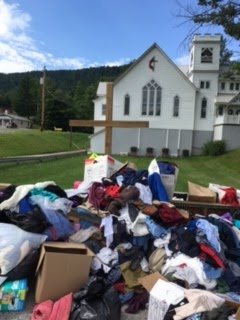
Scene outside Rainelle United Methodist Church

It's been a while since the last post. Late last week, I went with a friend from the WV Council of Churches to visit flood stricken areas. The Council has been heavily involved in disaster response for years. We made it to Nicholas County and Rainelle in Greenbrier, We hoped to get to Rupert and White Sulfur Springs from Rainelle, but the road was blocked.


There was debris everywhere and often inches of mud on the streets and inside affected buildings.


Many schools, such as this one in Richwood, were heavily damaged.

There were many striking images of erosion and roads washed away. 


And, while clear-cutting like that pictured above, wasn't directly responsible for the rain, it clearly didn't help.

Here are a few thoughts:

*The generosity of West Virginians is truly astonishing. There were many examples of people without a lot giving and doing whatever they could.

*The scary thing is that this didn't just affect low lying areas. There was so much water at one time that even homes on high ground were destroyed.

*I was deeply impressed by the Methodist pastors I spoke with who threw themselves into relief work in addition to their pastoral duties. And I know Methodists weren't the only ones. And I want to give a special shoutout to Team Rubicon, a veteran's disaster response group that really had its act together.

*At some point, can we start talking about climate change?

*There will be even more need for long term assistance when flood stories recede from the headlines.

*Finally, and sadly, there's a flash flood watch in effect for many of the hardest hit counties for tomorrow.